GAN-Based Two-Step Pipeline For Real-World Image Super-Resolution
Published Research Paper
This page provides a high-level overview of the research. The full paper contains detailed formulations, complete experimental analysis, and additional results. Please refer to the published paper for the complete work.
Abstract
Most prior approaches to image super-resolution rely on pairs of high-resolution images and their bicubically downsampled low-resolution counterparts, achieving strong results on synthetic benchmarks but struggling to generalize to real-world low-resolution images where degradation patterns are complex and varied.
This work proposes a GAN-based two-step pipeline to address real-world image super-resolution. The first stage trains a network to transform real-world low-resolution images into a space of bicubic-like images of the same size. The second stage applies a state-of-the-art super-resolution network (nESRGAN+) trained on bicubic downsampled/high-resolution pairs to upscale the transformed output. The proposed method outperforms existing state-of-the-art approaches both qualitatively and quantitatively across multiple benchmark datasets.
Methodology
The pipeline consists of two well-defined stages designed to bridge the gap between real-world degradation and standard super-resolution:
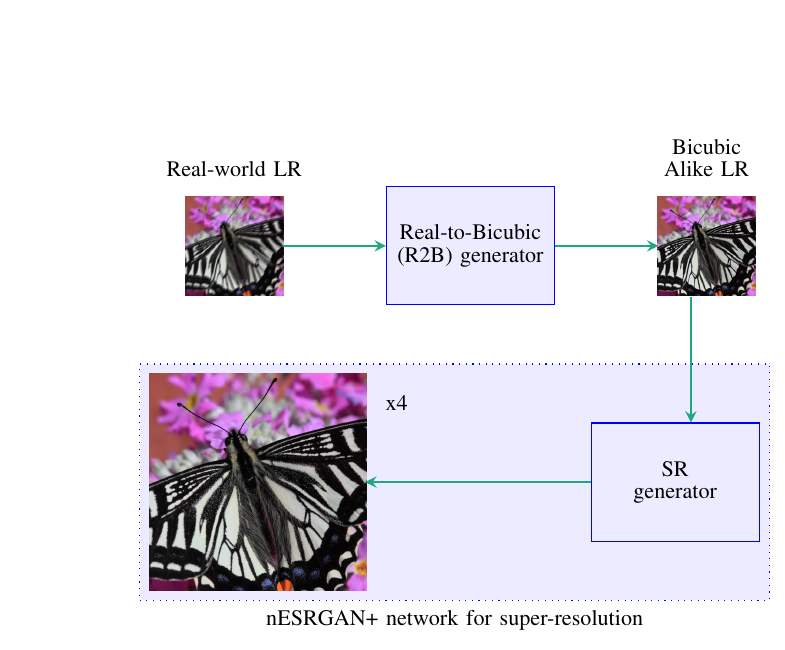
The two-step pipeline: R2B generator transforms real-world LR images to bicubic-alike images, then nESRGAN+ performs 4x super-resolution.
Stage 1: Real-to-Bicubic (R2B) Generator
A deep CNN with 8 residual blocks that transforms a real-world low-resolution image into a bicubic-like image of the same size. The network is trained using a combination of pixel loss (L1), VGG19-based perceptual loss, and adversarial loss with a Relativistic Average Discriminator (RaD). Training uses 800 images from DIV2K Track 2 and RealSR datasets, with bicubically downsampled HR images as ground truth.
Stage 2: Super-Resolution
A pre-trained nESRGAN+ model, which uses Residual-in-Residual Dense Blocks (RRDB) and noise inputs for stochastic variation, super-resolves the R2B output by a scale factor of 4x. By operating on bicubic-like images rather than raw real-world images, the SR network can leverage its full capability on a well-understood degradation model.
Key Results
The pipeline was evaluated on RealSR, DIV2K HR validation, and DPED cellphones test sets using PSNR, SSIM, and Perceptual Index (PI) metrics. The proposed approach achieved the best PI scores across all benchmark datasets, indicating superior perceptual quality compared to Bicubic interpolation, DPSR, RealSR, and RBSR methods.
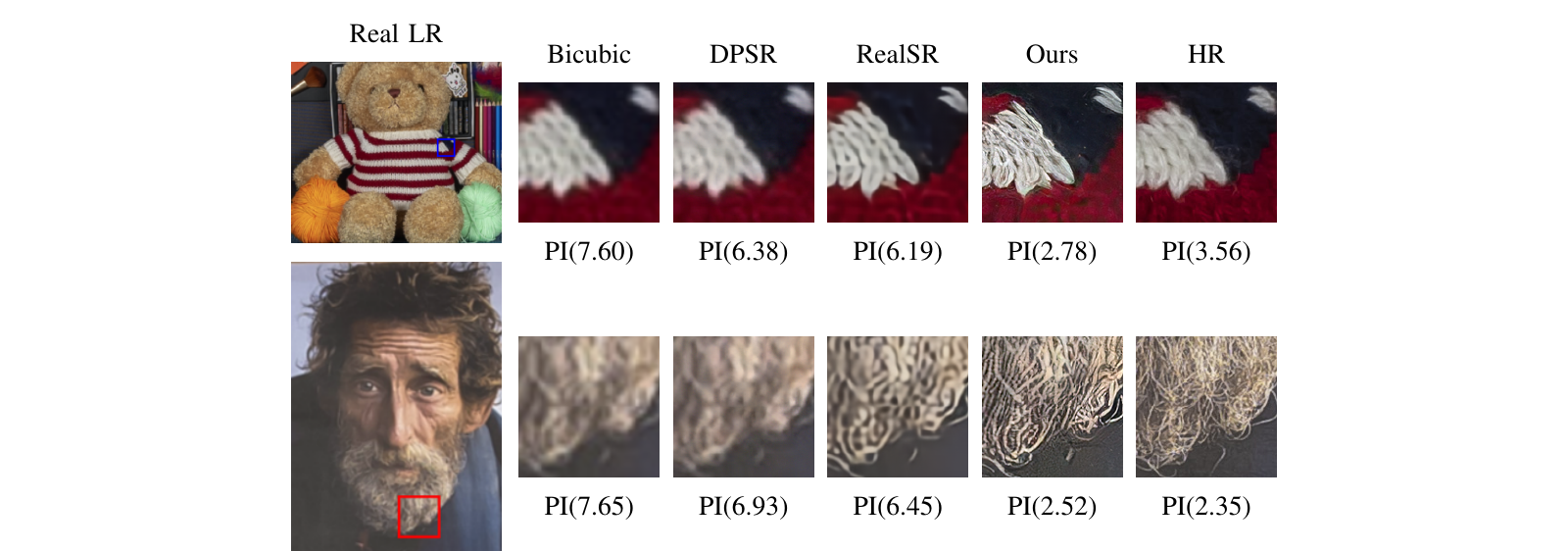
Qualitative comparison on RealSR images. Lower PI indicates better perceptual quality. The proposed method produces sharper, more detailed results.
Conclusion
The two-step approach effectively decomposes real-world super-resolution into two tractable sub-problems: domain translation (real-world to bicubic space) and standard super-resolution. By leveraging the strong performance of existing SR networks on bicubic degradation, the pipeline achieves state-of-the-art perceptual quality on real-world images without requiring end-to-end training on real LR/HR pairs. The source code and trained models have been made available for further research.